Sunday, April 13, 2008

In a small, dark cabinet under the bar, a vicious snarl of dark cables guards the open USB ports. I felt around for a place to insert a flash drive and hit my head. It was another Thursday Trivia Extravaganza at Champs, and we stalled while we tinkered with the projector that would display our questions on a big screen at the front of the bar. The usual crowd of ex-pats, Tex-Mex platters, and beer was on hand. There isn’t a great deal to say about it. Although some people are bound to feel that the contest is unfair, we still refuse to ask about cricket, former British PMs, and Formula One racing. These and other grumblings were drowned out by the din of conversation and the clatter of plates and mugs on servers’ trays.

On my way out of the washroom a young, skinny Lebanese man with a ponytail struck up a conversation about a company he had recently joined. As he explained the work, which was going exceedingly well for him, it became clear that he was describing a pyramid scheme. I tried to convince him of this but he became incredulous, even agitated, and moved to put the conversation to rest, summarizing his position with great conviction: “The market for making money can never be saturated. There is no bottom rung!” Beware the olive-skinned seller of souvenir coins.

Soon after the Trivia contest finished, the bar closed and I went to the road to hail a taxi.

It was after midnight when I stepped out on the shoulder of Ring Road. I crossed the wooden bridge over the deep gutter and walked onto the rough track just beyond. Some cars drove by on the main road, traveling fast; but because they didn’t honk they seemed quiet. The main sound that could be heard was a rhythmic chanting from a group of men crowded around a small fire in the scrubby area between the rough road and the gutter.

As I walked towards them more sounds emerged. The edge of a butter knife was tapping on a beer bottle and there was the shrill scream of a metal referee’s whistle. Plastic elephant horns, like the ones that were so ubiquitous during the Cup of Nations tournament, accented the chanting. They seemed to slice stinging crescents out of the heavy night air. There were about ten men by the small fire and most of them were in a tight circle, stomping around and around it in rhythm with their chanting, “HEY com bey sey la la la OH come bey sey la la la…”

About 20 feet away, across the rough track, two women sat on the edge of a cement slab in front of a metal shipping container that had converted into a barber shop. Beside each of them was a bare candle standing up on the concrete. The night air must have been very still not to blow them out. The women were wearing Western-style skirts and blouses, sitting comfortably with their legs extended and crossed at the calves. Each one held a bottle of Smirnoff Ice, which glowed in the soft light of the candles. I wanted to sit down on the slab with them and watch the men, but it seemed that I would have been gawking.

I continued past them, but then thought better of it and walked back to the women. When I came up to them I said, “Please, madam, I’m sorry. What are these men doing?”

“Our brother has passed away, one year today. They are mourning him.”

“Oh, Ok.”

I didn't sit down beside them, though I’m sure they would not have protested. Probably I could have sat there and the women wouldn’t have said anything more to me, in the remarkable way Ghanaians often sit together without talking at all. I wanted to ask questions about the chanting, what the words meant and which tribe it came from; but it was the wrong time for asking questions. I nodded deliberately to the women, wished them a good night, and turned around for home.

As I walked the short distance—not even 100 yards—along the rough track to the gate of my compound, the men’s chanting grew quieter, but the despairing crescent calls of the elephant horn could still be heard clearly. I went inside the house and the sound followed me there, too. It was like a dog pawing at the door to be let in. Sitting on the couch by the louvered windows, all at once I felt very lonely, like a clump of dried leaves and grass bobbing down through the eddies of a cold creek.

-----

Elizabeth, our housekeeper, injured her ankle almost two months ago. She was crossing a ditch at the market, walking on a plank that had been laid across it. The plank broke and she fell a couple of feet onto the uneven dirt. Her son Godswill, held on her back by the usual fabric wrap, was lucky not to be hurt.

I found out about the incident a couple weeks afterward when I called Elizabeth to ask why she hadn’t been coming by the house to clean. I said, “Elizabeth, we haven’t been seeing you recently.”

“Oh, Brother Jake, I’m sorry I haven’t been coming. I broke my leg."

“Oh, Elizabeth! What happened?”

“I was at market and I fell inside a ditch.”

“Oh! I’m so sorry. Have you seen a doctor?”

“Yes, I went to hospital.”

“And the doctor told you your leg is broken?”

“Yes. He said I have twist it near the foot.”

“Oh, so it is twisted. But is the bone broken?”

“Yes, the bone is not broken.”

We had reached the limit of our ability to communicate over the phone. Elizabeth said she would come the following Monday and tell me the whole story then.

When I came home from work that day I found her sitting on the front porch of the house. Her left leg was extended awkwardly in front of her, swollen below the knee and wrapped tightly in an Ace bandage from the shin down to the foot. She wore her usual wide smile and greeted me kindly. As we talked she described the accident and her visit to the hospital. The doctor had recommended she seek treatment at an herbal clinic. There they put her on a one-month regimen of weekly checkups and daily applications of a topical cream to the affected ankle. The cost was GHC 60, about half her monthly salary.

Elizabeth wasn’t told what was in the cream, but it seemed to be a mild analgesic. Patients at herbal clinics are rarely allowed to know what medicines they are taking, since most of them could be acquired much more cheaply at a local market.

There were good days and bad days. Sometimes her leg seemed normal and wasn’t painful or sore at all; other times, when it was swollen, she was forced to walk tenderly on it. She unwrapped it and rewrapped it tighter. On these days she sometimes described pain coming “from inside,” pointing just above her ankle. Through the ordeal she was convinced that the treatment was helping, though, and that she was getting better. She wanted to sign on for another month of the regimen, but didn’t have the money for it.

Last Monday her leg looked worse than ever, and I asked her to tell me again about her initial visit to the hospital. Now she said she had been x-rayed and that the doctor had first recommended a cast. Only when she refused did he refer her to the herbal clinic. I asked, “Why didn’t you want to have a cast?”

“Oh, Brother Jake, if I get POP [a plaster of Paris cast] then my leg would be too big. I could not put a slipper on this one foot. And I could not go to church wearing only one slipper.”

Sunday, March 09, 2008

George Tries for the High Note

In the weeks surrounding Valentine’s Day, which finds a devoted following in the residents of Accra, the local radio stations change their playlists. Edem from the Audit Department keeps his radio on all day, and the office is filled with love songs. Favorites include the original Lionel Richie/Diana Ross version of “Endless Love” and Minnie Riperton’s “Lovin’ You”. Those familiar with the latter (or with the movie “Vegas Vacation”) will know that it is notable not only for its sweet sentiment, but for its outrageous high note. Not many popular songs make use of the elusive whistle register of the human voice.

Nor is this lost on listeners at the office. There is a lot of humming and singing along with all songs, and there is a real feeling of anticipation when the unmistakable opening of “Lovin’ You” wafts out of the Audit corner. Most people are on board through “La la la la la/La la la la la/La la la la la/La la/Doo doo doo/Doo doo”. When the high note hits you can adjust your ear to hear a thin, quiet caterwauling from the desks of many big, hulking men who continue looking at their computer screens like nothing was going on. It sounds like recorder hour in the third grade mouse class.

The exception is George, who takes time out from work for the attempt. He puts his hands on the edge of his desk and pushes his chair out a little bit to give space. When the time comes he squints his eyes, tilts his head back, and tries to squeeze the note out from the base of his spine. He doesn’t get very close.

One time I asked him if he thought he could hit it. He said, “Yes, I’m going to get it.”

“But George, you’re nowhere close to it. You’re at least two octaves below it.”

“I know I’m not getting it now, but if I practice I could get it."

“I don’t think any amount of practice will let you get it.”

“No, Jake, I know I can do it. Hey, maybe on the weekend I can just stay indoors and practice it straight. If I come down—Doo doo doo/Doo doo—then the next part I’m going to get it.”

“Well, George, I’d love to see it.”

So the gauntlet was laid. For a couple weeks George updated me on his progress every day before lunch. He would sing the part as we walked down the street to the rice seller: “Okay, I’m coming.”

“Okay, George, I’m ready.”

He would put his hand out flat in front of him and raise and lower it with the pitch like he was marking out the tune on staff lines. The approach came, “Doo doo doo/Doo doo” (middle down middle/up up-slide-middle), then he would stretch his mouth into a wide, flat line, screw up his face, and send his hand way up while he tried to wrench out the “Oooohhh” from the very top of his throat. The hand always came fluttering down with his finger wagging while I started laughing. “I’m coming close to it. I didn’t get it yet but I know I will get it. I’m very sure of it. I’m going to get it!”

I’ll be sure to let you know if he does get it, but I still don’t think he will.

----------------------------------

Elephantiasis Lady

She sits on the sidewalk in front of the Central Post Office, around the corner from work. Her back is up against a low wall that forms the edge of a cement patio, which wraps around the outside of the Post Office. Most of the day the sun is behind her and she is in the shade of the patio.

She always wears the same flower-print dress. Maybe it was white once, but now it’s as grey as the sidewalk. She sits with her right leg flat on the ground, pointing straight out towards the street. Her leg is turned out slightly so her foot sags down to the side. A rubber sandal dangles by its thong between her first and second toes. It is badly askew like a sloppy wooden signboard in the Old West that says “Keep Out”.

Her left leg is bent at the knee. Its upper half is hidden by her dress and its lower half is ballooned up with elephantiasis. The flesh is so swollen that the network of tiny, fair-colored canyons in her skin has been forced out flush with the surface, where it appears as a web like the fat in marbleized meat. I have never touched it but you can see that her leg is scaly and hard. Her foot is swollen in the same way and it looks like a badly-drawn cartoon foot, like a football with stubby toes. I’m not sure whether the condition comes with chronic pain, but to see her leg you can only think that it must hurt all the time, some kind of dull stinging from the skin being stretched so taut.

All day she angles for coins from the passers-by, and she keeps the money in a thin red handkerchief that stays spread out on the sidewalk next to her. When someone presses a coin into her outstretched right hand, she slowly folds her rough, callused palm fully around it, and as she makes her fist she raises her head. Then she deposits the coin onto the handkerchief and replaces her hand in front of her.

During the few steps while I approached her, as I dug in my back pocket for some coins, I decided I would smile and greet her as I made the handoff; but when she looked at me I saw her eyes for the first time and got stuck. The centers were painted with milky clouds and the whites were a sickly, mucus yellow. My greeting caught in my throat and I just had to keep walking as I thought: That must hurt all the time, too.

--------------------------------------

Free Cinderblock

When a friend left two issues of Men’s Health on the coffee table in our house I was inspired to try one of the exercises inside. It’s a simple exercise:

(1) Find something pretty heavy

(2) Hold it out in front of you at chest height with your arms straight and your hands pushing in on its sides

(3) Put it down when you can’t hold it anymore

I knew that if I could do (1) I could do (2) and (3). But I found out that it’s not easy to assemble a home gym on a budget, even here in the capital city. I tried a plastic bag full of 30 water sachets but it was big and awkward to hold. Next I figured I should try a cinderblock. Luckily there were some nearby.

The land between my compound and the main road is divided into three distinct strips: first is a narrow, rough road the runs parallel to the larger one; second is a strip of uneven, dusty dirt about 30’ wide with some scraggly trees and scrub grass growing on it; and third is a wide, deep gutter.

Directly across the rough road from my gate on the dirt strip, in the shade of a wide neem tree, there is a neat pile of cinderblocks. There must be 100 cinderblocks there. I walked over and found a man sleeping on the ground with his feet up against the pile. He woke up when I approached.

“Good evening, sir. Are these cinderblocks for you?”

“No, they are for somebody.”

“Oh. Is he here?”

“No, he is not here now.”

“Do you know if he plans to use them?”

“Yes, he is using them.”

“What is he doing with them?”

“He is building a house.”

The cinderblocks in the pile are nice enough, but they aren’t the right amount for a house, even a very small one. The whole neat pile of them isn’t more than 3’x 3’x 6’.

“Where will the house be?”

“Just here.”

The dirt strip is also nice enough, but it isn’t the right place for a house. There are no structures anywhere along it, though it runs the whole length of the main road. It’s too small and scrabbly and uneven to do any serious building on.

“I don’t know if he can build a house here with these blocks.”

“Oh, he is building it.”

“Well, do you think he would mind if I took one block from here?”

“Oh, you can take all.”

“Oh, sir! I only need one. Anyway, wouldn’t it be difficult to build the house if I took all?”

“This man, don’t mind him. For the house, the blocks wouldn’t catch.” (To say something doesn’t catch is to say it’s not enough for its intended purpose. Taxi drivers will often tell you that your offer doesn’t catch.)

“Well, I agree. Anyway, I will be very happy just to take the one.”

“You can take it.”

So I took one of the nicest blocks from the top of the pile and carried it to the alley behind my house. We already had a good wooden pole with a bent nail in it, which could be wedged into the corner at the base of the back wall to herd the clotheslines to one side. That way there is plenty of space to stand up and hold the cinderblock out at chest height, then put it down when it becomes too heavy. Voila, home gym.

Wednesday, January 23, 2008

Have we done this before?

They woke me up for breakfast: a cereal bar, a banana, and a custard cup of orange juice with a foil top. Clunk, clunk is the sound of Ghana coming up under the wheels. Soon we are stopped and people are prying their plaid jute bags from overstuffed overhead compartments, and when the cabin door is opened the air rolls in like a hot fog. Down the stairs, across the tarmac, through the queue to the immigration officer whose accent is, for a second, too thick to make out. He is asking me how many books I’ve written, and whether I’m famous enough that he should get my autograph. On my entry card I’ve listed my occupation as “Writer”.

Outside I can taste the dust. It’s the Harmattan, O the evil Harmattan and its choking haze! Last year I lost my voice for two weeks when the cruel silt took up residence in my throat. It makes the morning sky look like a big brown smudge left by a junky pencil’s hardened eraser. And the taxi drivers, so anxious to help me home. Only GHC 15, you say?

It feels pretty automatic this time around. The lively taxicab tango (resulting in a fare of GHC 3) is a well-rehearsed show for no audience. When my pants start to stick to my shins after four minutes outside, I make a mental note: that’s probably twice as long as it’s ever taken before. After eight months of preparation the plastic sheeting has been removed from the edge of Cantonments Roundabout—also known as Deforestation Circle, for its center island full of venerable old trees that were chopped down in an effort to drive away the prostitutes known to hide from the police in their shadows at night—revealing an area of sparse grass with a sizeable podium in the middle. The statue on the podium is hidden under a cloak of garbage bags. My house has not moved, but the pitted track that runs in front of it has seen some repairs, as the deepest potholes have been filled with loose chunks of cement.

So some things are different; others are the same.

I walked into an empty house, put down my bags, and fell asleep. The first couple days always feel slow and arduous. I notice things that aren’t: the hours aren’t passing; the air isn’t crisp; the loved ones aren’t around; the acquisition of a good meal isn’t likely; the shower isn’t hot and the pressure isn’t good. Happily, Ghana is so many things that the tide turns irresistibly. The vegetable lady remembers my name and dashes me a mango. Elizabeth, our cleaning lady, has mounted festive newspaper pages and hand-drawn Christmas cards from her kids on the walls of our living room with medical tape. The newspaper pages are scrawled with kind messages in thick black permanent marker. I miss you, you are welcome! Well, I guess I missed you, too.

CAN 2008 is the biggest thing since Ghana@50. It’s the African Cup of Nations, the continent’s most soccer tournament, held every other year. From January 20 – February 10, Ghana is hosting the 16 best African teams as they play for a golden trophy and valuable bragging rights. It is no small matter.

In Accra alone the construction has been going on for over a year. The main sports stadium has been completely renovated and the deadly construction on the beach road was finally completed a day before the opening match. Imagine: they’ve turned the earth under every square inch of that road so many times by now, dug and filled and pressed and graded so many tons of dirt over and over with such hopeless Sisyphean sincerity that the project had become almost wholly symbolic—and they finished it. Curbs are freshly-painted and street lamps have been installed.

The people are also keeping up with the masonry. Every car—yes, every car—has at least one Ghanaian flag visible in or on it. Sales of whistles and plastic horns are through the roof. The plastic horns are in green, red, or yellow and they make a triumphant elephant sound. Those who can beg, borrow, or steal for them have bought CAN 2008 shirts. There are no less than 100 unique styles.

It’s not just for Ghana, either. Along the main roads, compound walls are draped with the flags of all 16 participating countries, and they’re all being purchased. Angolans, Namibians, Moroccans, even the much-maligned Nigerians are in the streets. With brightly-colored flags hung like capes over their bulging backpacks they are shiny, exotic beetles. Mostly they roam the terrarium freely, but they are sometimes forced to scurry aside when a herd of those damned hornblowing elephants comes trundling down the sidewalk.

So it is a real to-do, a combination of competition and pageantry that amounts to something like a medieval joust on safari. As such, it is not to be missed.

A well-connected manager at the office who has been sidelining with the company printing tickets for the entire tournament managed to wrangle one for me: blue section 13, seat S0050 of the popular stands (cheap seats) for the opening match. I gave that one to George to ensure his attendance; then when Sunday came we went to the stadium at midday to try our luck with the scalpers. How do we look?
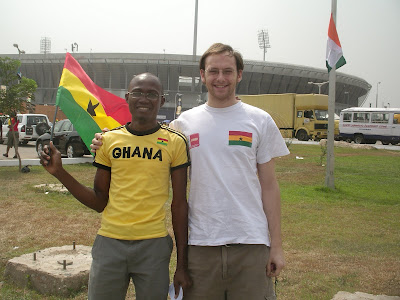
It was, as expected, a madhouse. All the red, yellow, and green paint in the city seemed to have been bought up and used to color the people walking around. They had been dipped like dark fried meat in fondue. It wasn’t too hard to find a ticket. It cost GHC 30 for a GHC 4 ticket, but that was what the market would bear. George feigned outrage (or wasn’t it feigned?) at the scalper, who happily exchanged blue section 12, seat U0002 for my three green bills. He added them an ample stack which he folded neatly in half and put in his pocket.

With tickets in hand we took some time to amble around the outside of the stadium and see what was going on: mostly rowdy fans and the noise of plastic horns, whistles, kazoos, and foghorns is what it was. One guy, though, was handing out little glossy prayer-a-day booklets, and another was promoting Trashybags, a neat organization that makes handbags, backpacks, duffels, etc., from discarded water and FanYogo sachets.

We went into the stadium around 2:15. The match wasn’t beginning until 5 but the gates were to be closed at 2:30 in order to “encourage” ticketholders to attend the opening ceremony in addition to the game itself. It worked. When President Kufuor and the heads of both continental (CAF) and global (FIFA) soccer governing bodies made opening remarks at 3 they were met with thunderous applause and not a little hornblowing.

The hour that followed featured a real spectacle with a cast of thousands: dancers, tumblers, men on horseback, etc. George explained that the first part was a visual retelling of Ghana’s evolution from disparate tribes to unified nation. One group represented each tribe, wearing its traditional dress and dancing its traditional dances. Gradually these separate groups coalesced into a single mass doing a single dance. Apart from these there were drums ten feet high, men dressed up as kings with huge gaudy golden scepters, and hundreds of dancers carrying giant crescent horns. Taken together, the performers’ costumes made a squirming kaleidoscope shawl of mardi gras sequins and glittery wet fish-scales in the sun, which the field wore with distinction like a bag lady movie star showing up to the Oscars drunk on good champagne.

There was also the part where everyone came out with colored umbrellas and glided into perfect formations: the flag, the outline of Africa, the tournament’s logo, etc.
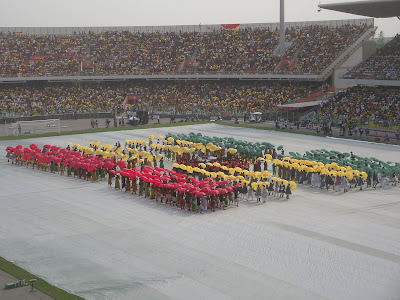
And that was before the game. A good hour before, actually. Once the spectacle ended the grounds crew came out and wadded up—did not roll up—the field-size white tarp and carried it off with some difficulty, revealing a yellow surface covering the middle half of the field. Many more workers rushed out from three directions with big cardboard boxes on their heads and ran to the edge of the yellow amoeba, which they began to dismantle pixel by pixel from the outside in. The amoeba was made up of thousands of interlocking tiles intended to protect the grass below. This was less of a precision drill than the performance. Tiles were removed in odd strips and shapes and thrown haphazardly into the boxes, which were quickly filled and carried off, leaving the amoeba only half-dissolved, pixels bleeding out onto the pitch. Workers looked around at each other confusedly for a minute and then resumed their work, now carrying the tiles to the edge of the field and heaving them over a waist-high barrier into a buffer zone between the closest seats and the field.

George watched the jumbled yellow piles grow and spread in the buffer zone and plainly saw the result of poor planning. He lowered his head into his hands, chagrinned: “They have failed. The tiles should have been attached to the white cloth. This is terrible. They have disgraced themselves.”

Later, with the field clear, the teams limbered up, the starting lineups announced, and the sun finally sinking, the match began. All the fans’ noisemakers, flags, face paint, and road flares had survived three hours in the sun and were fully functional. We happened to be in the unofficial Guinean cheering section (Guinea being the opponent) and didn’t realize it until well into the match when the differences in cheering became obvious. It’s hard to tell based on flag-colored attire alone. (See host's and visitor's flags below, respectively.)


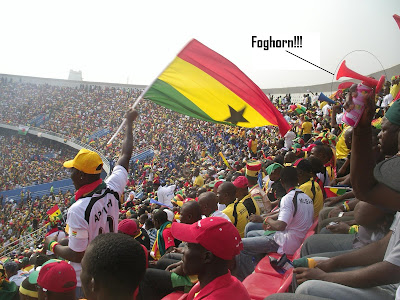
Towards the end of the first half two men walked up the steps towards our section carrying two large jute bags each. They stopped right near our row, unzipped the bags, produced two handheld foghorns, and declared, “Ten Ghana cedis!” Well, it was really a success. It wasn’t five minutes before they had sold all their horns to fans within twenty seats of George and me. Groups of people were pooling money to buy them.

What made them so great was probably the amount of sound you got in return for pushing a button with your pointer finger. Meanwhile, you could use your breath for screaming. One foghorn was easily equivalent to three or four plastic elephant horns in terms of decibels; and it produced a unique pitch which resonated with the cranial bones, creating the sensation of a balloon being inflated in the hollow pressure-point space behind all the listeners’ ears.

Understandably, they needed to be tested out. All possible combinations of short blasts, long blasts, and very long blasts were examined. The results were summarized in a comprehensive report consisting of a single continuous blast that lasted minutes and exhausted the compressed air in the foghorn of a man a few rows behind us. George, whose ears are tender, was beside himself. “We would have been better to see the match on TV,” he said; but I could tell he was enjoying himself.
The second half was coming to a close. Ghana and Guinea were tied 1-1 and the match was getting sloppy. The clock crept towards 90 minutes and an unsatisfying draw. Then in the 89th minute Sulley Muntari wound up and sent a laser from 20 yards out into the top right corner. The stadium erupted. For all the screaming I couldn’t hear the foghorns. People flailed wildly with uncapped water bottles in their hands, sending big sloppy arcs of warm water across the stands. George took off his glasses and waved his flag so hard I thought the plastic pole would bend in half. We were all soaked and the noise was deafening well through the ending whistle about four minutes later.

Afterwards, as we walked home past the cemetery, groups of wet fans with paint running down their faces lifted stuck cars out of the roadside ditch. There was music and honking in the streets, car horns and foghorns and plastic elephant horns.

Saturday, December 08, 2007

O the trotro is hot, and even though the temperature drops slightly as night falls it gets hotter still. At least I have a good spot. This trotro is actually an old bus. Its seats have been torn out and replaced by rows of small, narrow benches. There is an aisle up the middle and a two-seater to each side. Every row also has a jump seat that folds down over the aisle. I am in the second row jump seat.

To my right a man studies a small, detailed map of Great Britain bound into the front of his daily planner. The rider just in front of me gets up from his jump seat and turns around to face the passengers. He is wearing a dark blue suit and a limp necktie tied in a small, clenched knot. It looks like he pulled the knot as tight as it would go. He lays his briefcase on the jump seat, opens it, and pulls out a three-ring binder. Then he starts his pitch.

Every big trotro traveling a fixed route carries a salesman or a preacher. You can tell right away that this guy is the former, because preachers don’t carry briefcases.

The most common item sold on trotros is Smokers Toothpaste (with free hard-bristled toothbrush) from China. Typically sales pitches are done in Twi with bits of English thrown in for color and emphasis. For Smokers Toothpaste (with free hard-bristled toothbrush) there are phrases like, “Eye strong! Eye powerful! Eye natural!” (“It is strong! It is powerful! It is natural!”). Extensive pantomiming and gesticulating ensure that the deaf learn something, too.

A funny thing happens on a trotro when the pitchman starts to work: nothing. It’s nothing if he’s slinging secret herbal male enhancement pills from the jungles of Thailand and it’s equally nothing if he’s forecasting the End of Days. Like so many other smells and sounds and sticky heats, the pitch is inexorable; and as it is with those things, I can’t tell whether anybody else in this trundling heatbox even notices it.

As soon as he opens his binder we are sure that he won’t be selling Smokers Toothpaste (with free hard-bristled toothbrush) because he flips open to a laminated page with pictures of orange gel-caps and a lot of small Chinese writing. If it were toothpaste he would have just held up a sample. In fact, today we are being given a rare opportunity to buy a powerful orange Chinese wonder-pill, and let’s find out what those Chinese have jammed into this thing anyway.

On one hand it is a powerful curative. It can relieve:
· Leg pains
· Migraines
· Fever
· Insomnia
· Malaria
· Blood clot
· Spinal pains
· Pain in the joints
· Pressure in the eyes
· Stomach pains
· Running (diarrhea)
· Pain in the throat
· Cutter (common cold)
· Bad dreams

At the same time it promotes general health:
· Circulation
· Muscular strength
· Regular menstruation
· Virility (“Strong Penis”)
· Powerful Hips
· Warm chest
· Strong bones

And all this for just GHC 1 per pill. You only have to take it once to get all the benefits; but the more you take, the better. At a pharmacy they would cost at least GHC 10 each. This is a special limited offer for the riders of this car only. Who will take some? If there is no response he continues the pitch. Just look at your arms. (He holds out his arms wide.) The blood will flow freely and your arms will become more powerful. Your bones will be very hard. Just one Ghana cedi. No more tired arms!

While the man talks and pantomimes the riders sit mostly in silence. They don’t talk to each other very much. Once in a while one raises his hand. How many, sir? Just one. The salesman carefully shakes one pill out of the plastic bottle and places it in a tiny ziploc bag which is then passed back over the rows of passengers to the man. He puts the bag in his pocket or his briefcase. Then he produces GHC 1 and it is passed up to the seller.

A man sitting just to my left raises his hand and asks for one pill. The salesman shakes it out and puts it in the tiny bag and hands it to him. The man produces a GHC 5 bill. It’s the only bill he has. The salesman says, “Why don’t you just take five?” But he doesn’t want five; he wants one. “They are very good. No more back pains, no more migraines.” Pause. Well, alright. He’ll take the five then. He passes the tiny bag back to the seller, who has already shaken out the other four pills. They hardly fit when he jams them in there. The man accepts the bag and stares out the window.

This will continue until enough product has been sold. I’ve seen the pitch go to the bitter end. By then the salesman is repeating himself and trying to shove tubes of Smokers Toothpaste (with free hard-bristle toothbrush) into riders’ hands as they file hunched out of the trotro. Other times enough is sold in the first few minutes that he can get off and board another trotro long before reaching the destination. He always sells some, though, no matter what it is. I wonder whether people sometimes buy one just to make him feel good, or to get him to sit down and be quiet.

On this ride the man sells his share of orange pills within a half hour. Then he puts away his three-ring binder and takes out a box about the size of a cigar box. He smiles and holds it up for the whole car to see. The dramatic opening of the pitch. On the cover is a pornographic photo of a white woman bent over on all fours with a huge, musclebound black man behind her and with her face buried in the breasts of a blond woman who’s arched ecstatically backwards on a mattress. Since I’m sitting so close I can see by the trotro’s dim overhead light that the mattress is bare, and that the blond woman’s eyes are squeezed shut and her tongue protrudes just a little bit between pressed lips, as if she’s thinking very hard. There is no response from the other riders. It’s the same sweat and dank smells. He could just as well have been reciting Psalms.

I got off the trotro just a few minutes after he started into his pitch for the rare, ancient Chinese remedy for sexual dysfunction. (“Creates great warmth in the genitals,” etc.) By then he had just sold a few, all to a woman in the back who had raised her hand almost immediately and said loudly that her husband could use some. The passengers got a kick out of that. They must have been listening, after all.

Sunday, November 18, 2007

Our Waiter at Venus Bar

Matt and I sat down for a drink at Venus Bar. The waiter brought us our beers and we got to talking with him. He lives in Nungua, about 15km east of Accra, and has two children: a boy in high school and a girl in middle school. He smiled when he told us about them. His teeth were spread out and a little crooked like old white fence posts in his mouth.

He provides for the kids himself because his wife died from breast cancer about three months ago. Normally a person could turn to family for help in such a situation, but his mother and father and two siblings are also dead. They died on the way to a funeral in the mountains.

Matt said, “I’m sorry.”

The waiter said, “You can never know what will happen. That is life.”

Matt said, “Yes. Yours is a hard one, though.”

The waiter said, “Yes. Well, everything from God, you know? Everything in this life is from God.”

These were things he just said, as if he were talking about the weather. They were statements of fact. It seemed like the only thing we could do was to pour and drink the beer he had brought.

Boxing

Jamestown is a relatively poor neighborhood of Accra right by the ocean. Most of its residents are fishermen and traders, but it is best known for boxing (see stock photo above). The following is from Ghanaian law professor Josiah Aryeh’s memoir:

Accra Central is famous for boxing. A couple of generations ago practically every argument among the youth was settled with a fist fight and every neighbourhood had a clear pecking order. Boxing canalised those energies and calmed the youth. My half-brother, Charles Kweinortey Aryeh, was the founder of the world-famous Bukom boxing club. He was almost a generation older than the rest of us and his mother was a Sackeyfio in whose ancestral household the Bukom Boxing Club is based. My brother had developed love of the sport during his school days at Accra Academy when the Americans had considerable military presence n the Gold Coast. Accra produced a long list of Commonwealth boxing greats, including Roy Ankrah and Attuquaye Clottey but it was the Azuma Nelsons, D.K. Poisons, Alfred Koteys and Ike Quarteys who went on to become world champions. The great featherwieght Azuma Nelson shared many things in common with me.

(from http://www.ghanaweb.com/GhanaHomePage/features/artikel.php?ID=116989)

Last night a friend invited a bunch of us out to a boxing match to celebrate his birthday. There were seats for GHC 2 and GHC 10. We took the cheap seats. Entering though a small, low metal door in a cement wall, we walked through a narrow alley that gave onto a big open area with three basketball courts. There was a full-size ring set up in the middle of one of them, and hundreds of plastic chairs around in neat rows. Four bright bulbs lit the ring. They were hung from a cable stretched between two tall poles.

The first bout began just after we walked in and ended just as quickly when one boxer’s trainer threw in the towel less than 30 seconds into the first round. The second bout made it through the first round, but ended moments into the second when the referee called it on account of one boxer was leaning back on the ropes with his hands down getting pummeled mercilessly in the head.

Tiggy, photojournalist and girlfriend of the birthday boy, knew Daniel, one of the fighters in the third bout. He is featured in a photo essay she has been doing on one of the boxing clubs in Jamestown. We rooted for him while another group of spectators beside us rooted against him, chanting, “Die, Rasta, Die!”

The fight went all twelve rounds. The first six were full of good, tight boxing. I was surprised how clearly the sounds carried over the noise of the crowd. We were sitting at least 50 feet from the ring, but each falling blow could be heard; and the early rounds were full of the sharp staccato ksh! of the fighters exhaling with every thrown punch.

After a while things got sloppy. By the ninth round Daniel was lurching around the canvas with his hands down at his sides and his opponent was too tired or too disoriented to hit him. They threw wild haymakers that glanced off each other’s necks and shoulders, and their gloves started to look heavy. Daniel’s shoe came untied and the referee had to call a break. Despite obvious fatigue and the fact that their punches were starting to look desperate, there was still plenty of admirable clobbering going on in the ring. The drama was diminished, though: the dull raw-meat thud of a blow to the midsection while your forehead is buried in your opponent’s chest; the trainers’ violent fanning of the fighters’ faces in between rounds with hand towels. It was hard to keep in mind that these guys were here bashing one another’s heads in for our entertainment.

By the time the judges’ scores were announced, we had seen enough boxing. Daniel lost the fight by unanimous decision.

Children’s Story Fragment

Friday night after the boxing match I came home and ate a few forkfuls of three-bean chili I had left over from cooking the day before. Then I went to bed. That night I dreamed a fragment of a children’s story that has yet to be written. I hope I dream the rest. So far I have:

Lua was a great big blue whale, as big as any whale ever was, maybe bigger. Inside Lua’s mouth lived every single hippopotamus. Every last one, from the greatest to the smallest, from the wisest to the simplest—was there in Lua’s mouth. As for Lua, she lived in the sky, where she did her work moving the clouds. She swam there, pushing the big, white, puffy clouds across the sky with the great smiling curve of her mouth.

Thursday, October 25, 2007

I was going to write about my typical weekday lunch in an entry called “You’re Invited.” I would have described the rice and beans and stew I eat almost every day at about 12:30. Sometime I’ll get to it; the lunch routine isn’t going anywhere.

Matt told me he would take me to a birthday brunch on Sunday the 7th at Labadi Beach Hotel. He picked me up at 9 and we drove down Ring Road and then along the beach road. We parked in front of the main entrance and walked in. My mind was on eggs and bacon and the tiny glasses of fresh fruit juice they have. Mango and papaya and pineapple. Two steps into the lobby I heard the tune of Happy Birthday being played on the piano. I looked up and saw my mom sitting at the piano bench. You can imagine my surprise.

Well, I didn’t really know what to do. I think I quietly said, “Mom?” She was instantly recognizable in a familiar bright turquoise shirt.

She smiled and got up from the bench. I put down my backpack and gave her a big hug. We all continued to the restaurant.

I wasn’t afraid of waking up and realizing it had all been a dream; but the situation was fragile like looking down and realizing that the floor you’ve been walking on all along is made of lightbulbs. We had a big brunch and a cocktail outside by the pool afterwards.

Of course there were some particulars and real-life things going on. Nobody appears in the lobby of an African hotel just like that. There had been a flight and an itinerary and accommodations and all the other elements of an intercontinental journey. But the effect for me was like waking up to find everything covered with snow. Just like that, magic. Anyway she was here to wish me a happy birthday and she had a black duffel bag with her, full of gifts.

What else can you do but open them? Here on a hotel room bed in Nyaniba Estates, you can tear open brightly-patterned wrapping paper and wad it up and throw it on the floor, and get birthday presents. You can look through the What’s New section of the current issue of Popular Science and talk about the fancy futuristic gadgets in there, things like robot vacuum cleaners. Then you can plan to make spaghetti and meatballs for dinner, and think about when exactly to poach the four Bosc pears brought along just for that purpose. You might be thinking about the floor made of lightbulbs, and whether or not you’re actually weightless.

From Sunday until Wednesday we stayed in Accra. Mom came to the office and had a chance to see all the people I work with there. Some of them came out after work on Tuesday to a spot overlooking the ocean, and we had drinks and kebabs. Fred was adamant about ordering gizzard kebabs, so we ordered those and some other things, too. She got to eat the lunch of rice and beans and stew that I enjoy almost every day at around 12:30. She agreed that it was good.

We visited Peter (my first Ghanaian friend, the man who opened a snack bar a few months ago) and found that the snack bar was no longer standing. He told us that it had been torn down when vandals struck his house. Peter had intended to sell a portion of his land and hired a broker to manage the sale. Once a buyer had been found and some payment had already been made a serious misunderstanding came to light: the buyer thought he was purchasing all of Peter’s land, but Peter only intended to sell a portion of it. The sale was called off and the buyer was upset, so he sent a gang of thugs to Peter’s house. While he was home, they ran inside and ransacked the place and tore down the snack bar out front while they were at it. Apparently the broker himself was one of the thugs. When we saw Peter he was preparing for a court date. He is hoping to be compensated for the damage.

He has already made plans to reopen the snack bar. This time instead of a wooden structure he has ordered a sturdier, more secure metal container. He will be able to lock his goods and supplies up inside at night. The container will be painted red, white, and blue with the Pepsi logo. He expects to open in time for the Christmas season.

On Thursday afternoon we set off for Lome, the capital of Togo, about 100 miles east of Accra. We planned to leave in the early afternoon so we wouldn’t have to travel too much in the dark, but we had to wait almost an hour for the tro-tro to fill before leaving the station. The first two hours of the ride are over smooth, well-paved roads; but after crossing the Volta River at Sogakope the route is not so good. The tro-tro lurched and listed and swerved, and sometimes dipped a wheel into a deep pothole with a big, hard clunk and the whole vehicle shuddered. Mom described the seat as “a piece of plywood covered with a quarter inch of low-density foam” and she was right. The second half of the ride was like riding down a long wooden staircase on a piece of wax paper.

On the way I bought two loaves of bread through the window of the tro-tro while we were stopped. When we got to the immigration office at the border I gave them to the Ghanaian officers hoping the gesture would be a feather in my cap when they examined my visa, which was six weeks out of date. I thought the bread looked doughy and it felt like a soft pretzel when I poked it, but they liked it well enough to ignore the visa infraction altogether. So in the end I traded the bread for free passage, and that was a good trade for me. I’d say it’s on the order of trading a couple of saltines for a strawberry ice cream cone.

Once we were over the border Mom and I got to dust off the old French skills, which worked well enough to get us to a hotel with all our belongings minus four dollars.

Friday we spent the day walking around the city. Unbeknownst to us it was a Lome tripleheader: the last day of campaigning for legislative elections to be held Sunday, the pre-party for a soccer match against Mali that night, and preparations for Eid al-Fitr, the celebration marking the end of Ramadan. The streets were full of people in red and people in yellow (the colors of the two biggest political parties) having parades. Thousands of yellow plastic whistles had been distributed on account of the soccer match and people were blowing them nonstop as if they had never seen a whistle before. What’s this? Looks like everyone else is just blowing into this little slot…WOW! All that sound from this tiny thing? WOW! Just as much sound as the first time! WOW! It doesn’t run out! And so on. They didn’t tire of the whistles, and that gave the day a celebratory air.

We also walked across the beach that bounds the city to the south and dipped our feet in the Atlantic. The beach is hundreds of yards wide and, except for two neat rows of palm trees by the main road, completely bare. The only other people out there roasting in the sun were sweepers, sweeping the sand with regular bristle brooms. It was a big job they were up against: square miles’ worth of empty beach and not a trash can in sight.

The main market was not unlike Ghanaian markets. One big difference was the availability of couscous. A woman had a Tupperware bowl full of grey-white shards about the size of dimes. They looked like pieces of rock. We asked her what they were for and she made a motion as if to eat one. I told her, “I’m going to try it,” so I went ahead and ate one. It was just chalk.

That night we ate one of the best meals I’ve had on this continent. Tortilla chips and salsa, fattouch salad, a thin crust pizza, and a nutella and banana crepe for dessert. Also Belgian beer. The restaurant was outside in a courtyard with big trees and was gently lit by lamps covered by brightly-colored fabric shades in geometric shapes.

Sunday the week was up and I went with Mom to the airport to see her off.

I can’t find a good way to explain how happy I was that week. Imagine a day where you get four new packs of baseball cards and get to stop at 7-11 for a slurpee on the way home, and go waterskiing and then to the beach where the waves are big enough to body surf, then at night you get the brass ring on the merry-go-round. After a while you’d just think the whole world was full of only the best things.

--------

Last Friday I took a taxi from the office back to my house and I could tell that the driver was a nice guy. I knew it from the way he smiled and made conversation. On the way I asked him to wait for a minute while I bought some biscuits at the roadside. He happily pulled over and told me to take my time, he would turn the car around while I was buying the biscuits. When I finished he pulled up and we continued towards the house.

I told him, “I like the way you drive. I can tell you are in no hurry. I like that.”

He smiled very big at this and chuckled a little bit, and replied, “One night you will go to sleep and you won’t wake up. Any night you might go to sleep and you won’t wake up tomorrow. Once you realize that, why hurry? I am fifty-eight years old and I am doing what I love to do. Whatever small money I can take, that is God’s gift and I thank Him.” His words, and the whole car and everything in it, were filled with his smiling.

Sunday, September 30, 2007

Monday morning I left the house at the regular time, around 7:40. My house is at the back of a compound beside a small potholed lane. Beyond is a strip of dirt and high mangy grass and trees, then a wide and deep sewer channel with angled cement walls, and then Ring Road, where I catch a taxi each morning. I walked across the lane and the dirt strip and crossed the sewer on the same rickety wooden span as always. That left me on the shoulder of the southbound side of Ring Road, where I waited for a break in traffic and walked to the grassy median, then across the two northbound lanes to the other shoulder.

That’s how I get to the spot where I catch a taxi. Here you say “pick a taxi” instead of “catch a taxi”. The walk takes less than two minutes in all.

Taxis have no meters and I always negotiate the price in advance. Just about every weekday I take a taxi from my house to the office, and every time I pay 20,000 cedis. You might say that the price of that taxi ride is 20,000 cedis. But every morning we play a game, me and Taxi Driver X. The opening is simple and strictly-choreographed like a good, clean box step. He pulls over to the shoulder with the passenger window rolled down and I begin.

“Good morning, sir. How?”

“Fine. You?”

“Fine, thank you. I’m going to Accra, Wato side, near Post Office.”

“Accra Post Office. Hmm.”

“I will pay twenty.”

Normally this is where the game really takes off, but Monday morning’s Taxi Driver X immediately tipped his king and emptied his pockets. “Sit down,” he said, and I did. It was as easy as taking a ripe banana from a bunch.

We set off north on Ring Road and the driver made pleasant conversation. His car was neat inside and he kept the radio turned down low. The ride was a sweet piece of hard candy twist-wrapped in purple cellophane. He made an inexplicable U-turn, but I had total confidence.

It became clear that he was taking the High St route, through Accra’s biggest construction project. A two-lane road is being widened to four. It’s due to finish eight months ago or some other time, whichever comes first. For now the westbound lane is buried under the rubble of a sewer excavation. The two uncompleted lanes are a flattened bed of cracked clay soil and silty sand. They are so busy being used a diversion for the westbound traffic that there is no time to pave them.

On a hot, dry morning like Monday’s, a heavy cloud of fine dust and exhaust drapes itself over the construction zone, too lazy to get up and go to work. We crawled along westward. Somewhere near the Supreme Court Taxi Driver X shifted into neutral and the engine died. Immediately the cars behind erupted in a honking chorus. The sweet hard candy ride became ashes in my mouth. When it refused to start again Taxi Driver X jumped out and ran to the back to begin pushing, leaving the steering wheel unattended. Realizing his mistake he called me to the back to push while he took care of steering. The well-dressed obruni pushing a car through the choking cloud attracts laughter and calls of “Pusher! Pusher!”

After a short distance Taxi Driver X took pointed the car at a driveway to a vast dirt lot on the other side of the road. The car rolled dumb and heavy through the lane of slowly-oncoming traffic like a big, misshapen pumpkin that wins no ribbons at the State Fair.

Now sweaty and in a foul mood, I prepared to pay the driver half the fare and walk the rest of the way to work. But he didn’t have any change and suggested that I try and get some from the men hanging around the tro-tros in the dirt lot. One of them made change for me and I turned back to see the driver pushing the car down a natural incline to the corner of the lot farthest from the road. He had made over a hundred yards in those three minutes and was still pushing himself and his car away from me.

When I caught up with him I asked him why he was trying to escape from his paying customer. “The car, if I leave it there they will worry me.” I guess I wasn’t really expecting a better answer; anyway it was not necessary to look any deeper into the identity of “they” or the nature of “worry”. His response was a forgettable breakfast of plain crackers. There were no bacon and eggs underneath. I gave Taxi Driver X 12,000 cedis and began the walk back to the road. He ran after me to complain. My pants were sticking to my shins. It was around 8:05.

Approaching work I found that Josephine the Breakfast Woman had not come that day. On a wooden table in the car park across the street from the office she prepares bread with margarine, Laughing Cow cheese, marmalade, or fried eggs, and delivers it to the office when it’s ready. She also makes tea, coffee, and Milo (a chocolaty hot breakfast drink from Nestle). If she’s there I buy 2,000 cedis of bread and one triangle of cheese, and if she’s not there I usually don’t eat breakfast. But I was hungry from the pushing and walking and had been looking forward to placing my order. Disappointment made my briefcase heavier and its strap dug into my shoulder as I crossed the street towards the office.

As I reached the first floor landing I saw Josephine’s daughter Rachel in her school uniform carrying a wicker basket full of polythene bags. She called me over, poked around in the basket, chose a bag, and handed it to me. “My mom couldn’t come today but she made yours.” It was the usual small microns-thin black plastic bag, its handles tied into a tiny intractable knot. Stapled to the bag was a small strip of paper ripped from a ruled sheet. There was my name, “JAKE”, written on the strip in pencil. Inside was my bread and cheese.

That bread and cheese was a good breakfast, and it was also a sponge that wiped the whole day clean as a smooth countertop. The morning’s events flew right off like dry crumbs.

At precisely noon every weekday a siren moans over Accra Central. It sounds just like my idea of an air raid alert: a low, quiet start that crescendos as it slides up to the main pitch. That pitch sits there for a few seconds, open like a cartoon mouth in the downward-U shape of the entrance to a dark tunnel, with no teeth or tongue visible. It is a hollow, vaulted, echoing sound. To me it has come to mean lunch.

George and I walked out the back entrance of the office and around to the street. The building next door is four stories high like ours. At noon on Monday its front was obscured by a clutter of rickety scaffolding. All the way up by the roof two men teetered on a precarious platform of loose boards. They leaned against the wall of the building with chisels and mallets, tink tink tink—pause—crisp woody crack of breaking pottery. They were chiseling tiles off the cement façade of the building. Once free from the façade the tiles and mortar didn’t waste any time. They got right on falling and shattering on the sidewalk below. Some rotated and toppled gracefully and others just bombed straight down without any acrobatics.

So their performances varied, but the finale was always the same: every piece of falling debris hit the sidewalk and flew apart. No kind of barrier had been erected around the scaffolding, so the general downtown public was free to participate. You could watch debris fall down and shatter from any vantage point you wished. You could stand directly underneath the scaffolding if you were feeling adventurous.

It was necessary to make some adjustments. Anybody who wanted to walk past the building and avoid the debris, for example, had to make a wide arc into oncoming traffic. The man who sells mobile phones and accessories out of a glass-paneled wooden case along the sidewalk there smartly set up shop behind a low cinderblock wall. That kept his goods out of harm’s way. Still, not many customers had come by that day. He knew they were being driven away by the threat of injury and was annoyed about the construction work, but didn’t see any good solution. He summarized his assessment with a scowl and a disapproving shake of the head: “You know these boys. They get thousand cedis and they would bring something new. Who for complain? They think they are big men.”

George and I watched a few more pieces of debris fall and then swung a wide arc into the road on the way to the lunchtime rice vendor.

Friday, September 14, 2007

Most taxi drivers in Accra decorate the rear windows of their cars with stick-on letters in wavy fonts. A good portion of the messages are in a local language (usually Twi), and the majority are religious—usually either direct Bible quotes or chapter and verse references. Some are otherwise. “Shut Up” and “Respect the Hustlers” are two of my favorites.

But one taxi stands out. I have seen it three times, always a momentary glimpse as it darts off onto some impossible side street. Fortunately my friend Matt is keener and nimbler than I; when the elusive beast showed itself he was ready. Here it is:

What does it mean? Is it an algebraic statement? A garbled sentence of symbolic logic? Pure philosophy? Monkeys at typewriters? Three ideas:

(1) “Don’t worry about what anybody else is doing; take care of business.” This reading was suggested by Amanda Johnson, who works at the desk opposite mine. Different people see the world in different ways, but each of us is at the center of his own universe. The clause “If 7 + 2 is = to 11” is the logical conclusion of the fact of difference: in the extreme case, everyone else agrees (and what is that but a universal law?) that 7 + 2 = 11. However disconcerting this may be, the second half of the sentence still follows. One is stuck in one’s own universe always and everywhere, and only through one’s tireless effort and action does it keep from total collapse and the annihilation of its very center. There are mouths to feed and bills to pay, laws and conventions notwithstanding.

(2) “Math is for the birds.” This is probably the straightest reading. Exploiting the lack of punctuation, we can invert to get “Who cares if 7 + 2 is = to 11”. But, in my view, this interpretation can be rejected on aesthetic grounds alone.

(3) “Conventions are the glue that holds the universe together.” Read “If 7 + 2 is = to 11, then who cares?” Indeed. If the most fundamental truths were violated, who would care about anything? If the sun rose from the west and the sky turned orange, would we not devour ourselves in a massive primal orgy? Would Starbucks fail to open on time? More precisely, if our most fundamental truths are actually false, then we are utterly lost, here and now. I suppose this is simply a variation on (1). Here the “If 7 + 2…” is taken to be a “real” fact (how did we get it wrong?); and we are so helpless in our misperception that the universe threatens to cave in.

The Twi phrase “Efa Wo Ho Ben?” simultaneously supports (1) and undermines the entire exercise. It translates: “Is it your concern?” Reinforcement, or meta-commentary? Never underestimate the subtlety of Ghanaian taxi drivers.

-----

It seems like more and more planes pass over the roof of my house. They make a noise like an angry milk steamer. I usually imagine a big ravenous machine mouth with gnashing metal teeth, furiously eating its way across the sky.

Monday, September 03, 2007


Three weeks ago today I was back at Safari Beach Lodge. The day was hot and bright. Pamela and I walked a couple miles down the beach to the point, climbed around on the rocks, and walked back. We ate as well as ever and after dinner Saturday we went for a short stroll. The night was very dark and the foam from the breaking waves rolled in and spread smooth arcs down the beach like bunting of rich white velvet. It seemed to glow. Phosphorescents in the sand set off pinprick flashes of green light with every step that burned and died quickly in our footprints.

If it seems like a dream, maybe it was. Safari is a real place, but the times I’ve been there the elements have always conspired to make it seem otherwise. The fact is that all you have to do is show up; then sometime during dinner once it’s dark you look up from your kingfish and see the paths winding through the palms from the main building to the bungalows, and all along the paths are little posts with oil lanterns hanging on them. Beyond the lanterns’ light there might be nothing at all but the soft rumbling of the waves and the clatter of palm fronds in the breeze. Your thoughts haven’t ventured beyond the ends of the long, curved beach since you arrived. It could just as well be an island in your mind.

We were back in Accra by Sunday night, picking our way through the cacophony of honking and lurching vans at Circle, eventually jamming ourselves into a tro-tro bound for Danquah Circle. Back to “reality”.

The real purpose of this entry is to say a little bit about my friend Aziz Mohammed (at right above). He is a member of the Africana dance troupe, which I’ve written about before. I knew him only in that capacity until Cathy came to visit in the spring. The two of them were fast friends and they kept in touch after she left. When I returned home in July Cathy gave me some money to take to him. She said it was a contribution towards his AIDS education program.

That was the first I had heard of it. Aziz explained it to me when I next saw him: for the past 18 months he has been working with a group of about 30 kids (mostly teenagers) from a section of Accra near where he lives. His main goal in organizing the group was to give the members a safe, wholesome place to go and a positive community to belong to (think Boys & Girls Club); in addition he has tried to spread the good word about sexual and reproductive health.

Most of the kids come from Nima, a predominantly-Muslim neighborhood. Two-thirds of them are girls. According to Aziz, some of them, and many of their peers from the neighborhood, have been pulled out of school early—or never attended at all—so they could earn money. Typically such a girl would spend the day at the roadside walking up and down with a tray on her head selling fruit or water sachets. Most of them will marry young and start having children in their early twenties. They will spend most of their young-adult and adult lives contributing to Ghana’s astronomical fertility rate.

Aziz isn’t a doctor or a public health professional, though—he’s a dancer (see above). Fortunately, the kids prefer dancing to lectures on sexual health. So that’s what they do for a few hours, a couple afternoons each week. They meet at the Nima/Mamobi Learning Center, a spiffy new building recently erected by a Canadian NGO. Inside is a performance space with a stage, a sound booth controlling two powerful speakers, and a full backstage area. The Center’s director agreed to let the group use the facility for free. At a typical weekday meeting, small subgroups learn and rehearse dance routines that Aziz choreographs. Mostly they dance to recorded music, but sometimes Aziz (who is also a drummer) is joined by some percussionists from Africana to provide a live soundtrack. Many of these are “dance dramas”—stories told in words and movements—that illustrate issues in sexual and reproductive health.

Every few months Aziz puts together a program to give the group a chance to perform and to try and spread the word to the community at large. Normally he picks a theme for each program. The last one was about AIDS. Hoping to draw a large crowd, he put up posters around town and asked the principals of local schools to mention the program to their students. He wrote an invitation to his District Assemblyman (a local elected official (roughly the equivalent of a borough president) and went to the Ghana AIDS Commission to request that they send a representative to speak, or at least provide some of the pamphlets and booklets they had given out in the past. In order to avoid any suspicion that he was out to make a profit, he was adamant about asking for non-financial support. (The money to put on the programs comes out of his own savings, plus voluntary donations.)

His District Assemblyman never replied to the invitation, but Aziz visited his office in person and was assured that he would attend. The AIDS Commission also agreed to send someone to give a short lecture on AIDS prevention. But when the day came, the Assemblyman didn’t. Neither did the speaker. Watching the room fill up with neighborhood kids, Aziz tried unsuccessfully to get in touch with the AIDS Commission and eventually dashed across town in a taxi to the office, where he was told that they had never heard of his group or its request.

This all came as a crushing blow. Here was a completely homegrown and genuine effort to improve the community, ignored by the very institutions whose job it is to encourage and support such programs. Through Africana’s interactions with (mostly do-gooding) foreigners, especially its close relationship with the Canadian volunteer placement organization Volunteer Abroad, Aziz knows how much support there is (in word, if not in deed) in the broader development community for programs like his own; but this was a local project, and he had hoped to show that the local community was behind it. No number of well-meaning foreigners can stand in for a District Assemblyman. Advice about AIDS prevention plainly sounds different when it comes from someone who knows the environment in which her audience lives. (It could also be given in Twi.)

But this isn’t a sob story, though Aziz did get heated when he told it to me. After the AIDS program he considered disbanding the group but decided against it. “The kids love it,” he said. He is certainly not a martyr—he really enjoys teaching dancing and watching the kids improve. Above all, he completely avoids the extremes of cynicism and self-righteousness. He speaks with Zen-like clarity and directness about the whole situation. “I know it is a good thing we are doing. We are helping each other. Even though we can’t get the support we need, we will keep trying.”

Two weeks ago Saturday we sat together in the Learning Center while the group rehearsed. That’s when he told me all of the background information above. While he spoke he watched the dancers out of the corner of his eye, occasionally yelling some instructions or clapping at the end of a routine.

Everyone wanted to get it right because they were preparing for another program coming up in a week. This time the theme was “Send the Girl Child to School” and Aziz wasn’t relying on any external assistance (though he made good use of Cathy’s and my donations). He hand-wrote flyers on the backs of glossy posters he found around town and put them up in the neighborhood. Because no one was coming to speak, he added an extended drama piece about girls’ education. He also took me up on my offer to make copies of a half-page typed handout about the importance sending girls to school. In order to increase the participation and get the word out, he personally invited dance groups from local schools.

Last Saturday was the big day. I arrived at the Center around 10am, the advertised starting time, and found the performance space filled with rows of empty wooden folding chairs. There was room for at least 200 people to sit. The program hadn’t started yet, and by 11:30 there were still only a few seats filled. The emcee finally took the stage and announced that the show would be starting soon. But while we waited, wouldn’t we like to see a little dance contest? For the next 45 minutes audience members took the stage three at a time and danced to blaring, fuzzy music (mostly it was P-squared’s “Al-haji”, an Ivorian song that, to me, is the aural equivalent of getting hit square on the head over and over with a mallet). Winners were declared by the applause and hollering of the sparse audience. It seemed like a wash-out.

Once the contest ended I roused myself from the stupor induced by the repetition of that awful song and got my bearings. Many more seats were filled. Aziz was introduced and talked for a couple minutes about the program and its message. Considering the way I’ve seen him throw himself around a stage during Africana rehearsals and performances, he seemed remarkably shy speaking in front of an audience. “Let’s get to the dancing!” he said, and out they came.

Most of the next four hours were filled with hip hop and R&B numbers, with a few notable exceptions. Three girls read poems they had written. There was a longer dance drama about a girl taken out of school to sell pineapples who is then raped by some delinquent boys from her class; the story ends when she discovers she has AIDS. There was also a more uplifting short play in which a mother recounts to her daughters her own struggle to get an education. When her father insists on sending her dimwitted brothers to school instead of her (reprimanding her that she should be in the kitchen), she and her supportive mother walk out. She endures her mother’s untimely death and the prejudice of both her teachers and her classmates, and through a mix of patience and tenacity finally becomes a doctor. Both the dance drama and the short play were shot through with comedy, and the audience—which by that time had grown to over a hundred people, mostly teenaged girls—was thoroughly engaged throughout.

After an incredible ballet piece by Aziz and some of the Africana dancers (where did they learn that?), the program was over. When I walked out, most of the 200 handouts were gone, hopefully bound for the audience members’ homes.

Aziz was also in a hurry, rushing across town to the Trade Fair to perform with Africana at a “Fit for Life” program. But he stopped to thank me for coming and to invite me to an Awards Dinner that night. “The kids have done such a great job. We want to recognize them,” he said.

At 8pm back at the Center, after an hour-long performance at Trade Fair and another mad dash across town, Aziz was exhausted, nearly asleep but running around making sure the food was arriving, popping caps off bottles of soda, joking with the kids, sliding across the stage lip-syncing to an R&B ballad. I didn’t see him sit down once. By the end of the night his energy, and his savings, were utterly depleted from the events of the day. But his spirit was plainly not. Instead he seemed to be fueled by the expression of gratitude for others’ efforts. He thanked the kids and gave out awards to some of the dancers and thanked the Canadian woman for the use of the space and even thanked me, “our special guest from the US”, much to my embarrassment. It would have been ridiculous if it hadn’t been so utterly and obviously genuine.

I have often been told that those fortunate enough to have plenty should give some back. Among other things, it has engendered some sense of obligation to share some of mine with them. I think it is different with Aziz. What he gets is ours before it is his at all. But this analysis fails to capture the spirit of what he’s doing; at any rate he doesn’t articulate it in these terms. He makes it simpler. Here are some good kids and I have an opportunity to share something nice with them. They might even come out better for it. So let’s do it. What’s so complicated about that?

Do you love Aziz yet? I will be happy to forward any questions, comments, responses, expressions of admiration, etc, his way. Just email jacob.appel@gmail.com.

Saturday, July 28, 2007

Home Again


I practically ran from the customs check out into a muggy Friday afternoon in the bowels of Terminal 4, JFK. Winding up around a helix towards the Airtrain station it was white face after white face and I was bouncing along with Medeski, Martin and Wood. The pack on my back weighed nothing. There is an elevator that climbs two stories from ground level to the platform. It is a shiny glass box. The platform is scrolling LED banners and a cheery bing! announcing the arrival of each sleek monorail snake. Last stop on the Airtrain is Jamaica station, transfer to the subway and the LIRR. But first you need a ticket.

Great banks of touchscreen Metrocard machines stood empty waiting for poking fingers; bing! and the hall was instantly inundated by the passengers from the Airtrain. They formed orderly lines behind each machine. I stepped up and was walleyed—I’ve bought a thousand Metrocards but only for the subway. Besides, it was all discrete options: Refill or New Card? Airtrain+Metrocard or just Airtrain? I asked the man at the machine next to mine but he was equally confused. We were both strangers. Around us people approached the machines confidently, danced through the options, and marked the time while their debit cards processed with anxious foot-tapping. I wanted to tell someone, “I need to get to Penn Station. How should I go?” But this was a time for the poker face. Aware of holding up those behind me, I sheepishly canceled my transaction and walked back to the end of the line to watch what the others did.

The second time around I got a card and walked through a futuristic gliding two-paned gate that opened and shut in perfect silence.

The LIRR train was full of people heading into the city for a night out, dressed up, drinking brown-bagged cans of beer, talking a mile a minute in thick Long Island accents. I felt like I knew everyone on board.

The man in the seat in front of me takes Fridays off in the summers and usually spends them with his son; but tonight he was meeting “the boys”. He was sitting with three women friends he had run into on the train. They were on the way to a girls’ night out. Their banter was incredible—Work is slow and How’s Bobby and Gawd, that night don’t remind me. They seemed to manage a comprehensive review of the months since they had seen each other last.

(You might remember from an earlier posting this story about Oti: Driving through the neighborhood he spotted someone walking and, seeming excited, pulled over to greet him. “Charlie, How?” “Fine. You.” “Fine.” “Nice.” And we drove away. A few seconds later Oti said, “That was my good friend. I haven’t seen him in years!”)

Next, the incredible herd moving through Penn Station and onto the subway platform. In Accra I have a basic policy of looking twice at any obruni I see on the street. The ex-pat community is small and incestuous enough that I have a fair chance of knowing a random white face in town. The technique doesn’t play as well in New York. Ambling down the platform I looked half a dozen people up and down thinking, Don’t I know you? Were we in a class together sophomore year? Or maybe I was just looking for that glint of recognition in the great underground hive of anonymity. The subway! Nobody met my eyes.

Got off at 18th St and walked up to street level where I approached a punkish girl dressed in denim and black with spiky hair and asked to borrow her cellphone (mine had a dead battery). She happily assented. Glancing up the west side the block (8th Ave between 16th and 17th) I counted four restaurants: Thai, Mexican, sandwiches and wraps, and a diner. Exactly none of those foods is available in Accra.

Two hours later I was walleyed again in the great hall of Grand Central Station. I stepped up to the ticket window and spoke to a real person: “One-way to East Norwalk, please.” “What?” “Just one single, one-way to East Norwalk, please.” “No East Norwalk.” “Oh. I thought there was a train at 9:17.” “Not to East Norwalk.” “Is there any train that stops there?” “No.” “Um…” “Listen, there’s no station at East Norwalk. Where do you want to go?” “Well, it’s one of the Norwalks.” “Not East.” “Okay, what Norwalks are there?” “The 9:17 stops at South Norwalk and West Norwalk.” “Well…South Norwalk then.” “Ten twenty-five.” I only had a twenty. “Sorry, I don’t have a quarter.” He was visibly irritated; there was a line behind me. By the time I got my change I had taken at least 90 seconds in total.

I have never been a good golfer and this vacation was no exception. But a couple miles’ walk with my dad, uncle, and cousin on the verdant green carpet of the Weekapaug while the morning sun burned the dew off the back nine—golf didn’t have much to do with it. We returned home to a table erupting with bagels, cheese, five kinds of smoked fish, fruit, juice, and coffee. I ate a bagel cut in quarters with a different kind of cheese melted on each piece. On the porch we talked and read the newspaper; some of us fell asleep in hammocks or Adirondack chairs. There are spots in the shade and spots in the sun, and spots under a leafy tree that provide some of both. Out in front of the house the bay was full of ripples.

After the weekend we went back to Montclair where I slept in my own bed, sat on the swing on the front porch late at night, played the piano, and ticked off the episodes of the final Sopranos season On Demand.

The night of July 3rd was the annual campout at Caumsett State Park on the north shore of Long Island. Five of us rode Rich’s Buick down the dirt track to the fishing beach. We set up camp just before the sun set and started the charcoal going. Some time later the park security came and made us take down our tents, but by then we were a couple beers deep, eating sausages and watching across the Sound as nine simultaneous fireworks displays bloomed over the Connecticut coast. We weren’t going anywhere. The night was a success. In the end we rolled out our sleeping bags in the open and got ravaged by sand fleas.

Returning to the parking lot in the morning dragging coolers, tents, and trash bags, we found the Buick under investigation by official types who wanted to revoke Rich’s fishing permit. Adam, far and away the best negotiator in the group, made an effort at damage control, but his overtures were roundly rejected by a smug officer not much older than ourselves. Growing tired of our appeals, he addressed all of us: “Hey, I could give you all summonses for trespassing. How would you like that?” As we looked around blankly (How could one reply? Oh, please, anything but that! We’re so sorry!) I think he realized how much of an ass he was being. His demeanor changed and his chest deflated slightly under his blue uniform. They took the permit and sent us on our way.

On the weekend we went back up to Rhode Island and to the bay full of ripples. It was late one night and four of us shoved off in a rowboat. The bay was quiet and dark except for a bright spotlight shining from beyond the golf course that runs along the eastern shore. At times it seemed to follow us. For a while we rowed towards the sandbar hoping to walk around, but after a few minutes of hard pulling in the channel found that we were fighting against an incoming tide, going nowhere. Instead we turned and made for the house and found ourselves assaulted again by the squinting, bright-white ember of the spotlight. A row of young evergreen trees along the edge of the golf course obstructed the beam, and the light played through like rays from a UFO. My cousin said, “I’ll do a monologue on the light.”

If we shadows have offended,

Think but this and all is mended,

That you have but slumber’d here

While these visions did appear.

And this weak and idle theme,

No more yielding but a dream,

Gentles, do not reprehend:

If you pardon, we will mend.

And, as I am an honest Puck,

If we have unearned luck

Now to ‘scape the serpent’s tongue,

We will make amends ere long;

Else the Puck a liar call:

So, good night unto you all.

Give me your hands, if we be friends,

And Robin shall restore amends.

On the way in the oars lapped the water like wooden tongues and the oarlocks squawked with each stroke. When the boat crunched up against the sand we got out and fixed the stern line to a cleat, then heaved the anchor out into the bay where it landed with a hearty plop. I could hear my aunts’ and uncles’ voices on the porch, desultory conversation and laughter.

Wednesday night I was back in New York on 19th St near 5th Avenue. I met my friend outside her office building and we walked to Madison Square. There was a small, open tent set up and about a hundred folding chairs, and the warbling sound of a Hammond organ. It was the Lonnie Smith trio, playing a free concert as part of the park’s summer series. We found a bench next to a lawn dominated by a large sculpture that looked like a big, leafless tree dipped in liquid silver. The Flatiron building glowed in soft evening light. I felt full to the brim and perfectly light, as if I had taken a deep breath of spearmint-sharp air that filled up my whole body down to the tips of my toes.

My aunt once wrote, “I feel like a balloon on the fingertips of everyone I’ve ever loved,” and mostly I felt so buoyant. But my family also gives hugs as filling as Thanksgiving dinner, and I had many helpings. They say you can never go home again, but they’re wrong.